Saturday, February 26, 2011

No epoxy

It has been really cold this week, so for the most part, working with epoxy hasn't been much of an option.


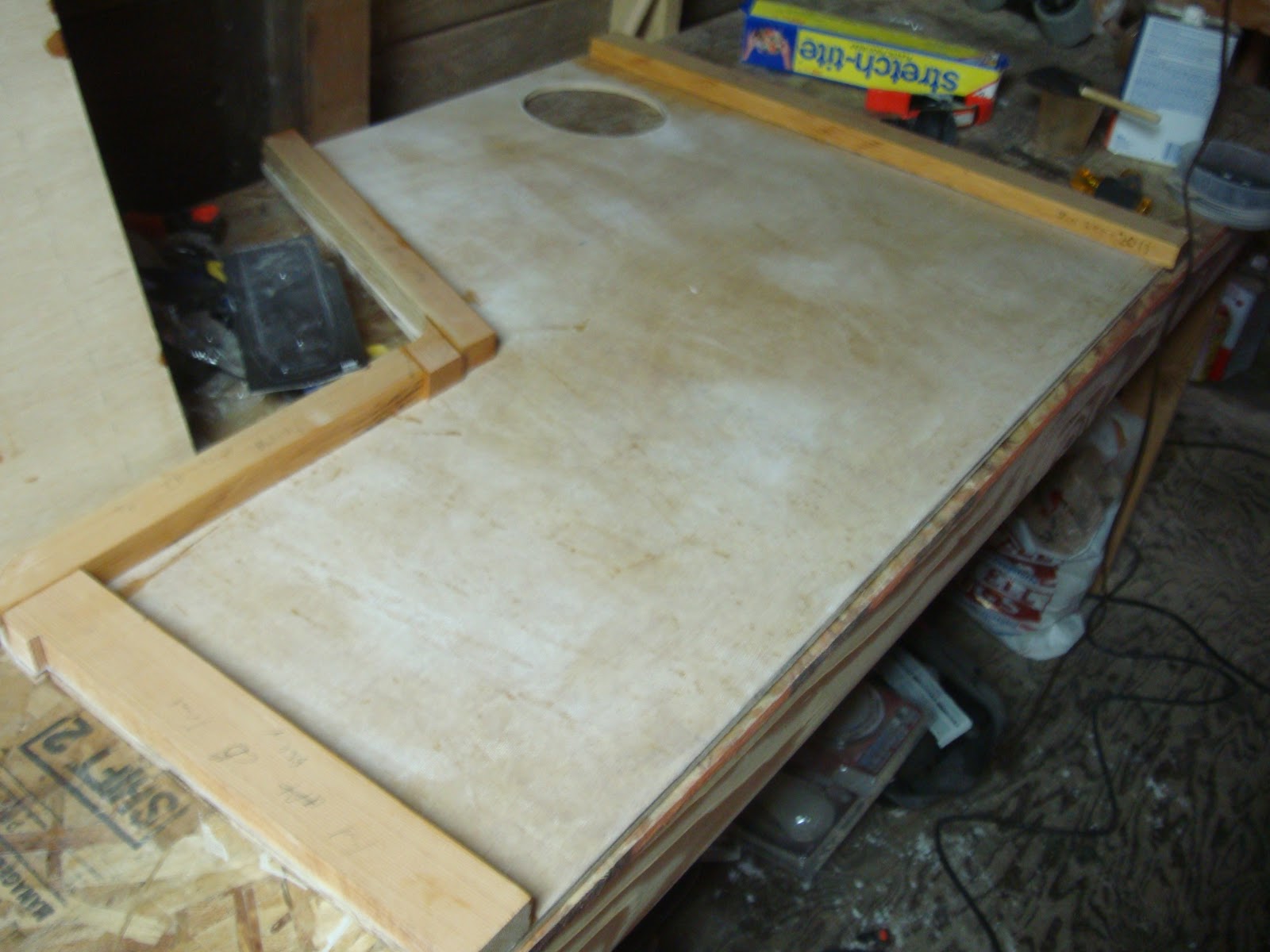
One of my top priorities this week was to lay out and cut out the bilge and topside panels.  In this endeavour, I succeeded.  Laying these panels out was quite an adventure.  Aside from using an awl to transfer the sixteen foot long panels, stitch locations, locations for the bulkheads and floors, and the portholes all had to be transferred.  The manual says this a lot of awl work.  I say it's an awl-ful lot of work.   Making the dots was one thing.  Going back with a pencil and rule to ply connect the dots....yipes.  Once all that was done, the circular saw make quick work of the cuts.
 
Cutting out the bilge panels

The topsides panels emerge.
 As I had feared, the scarf joint on these panels were as ugly as those on the panels.  So, there will be some epoxy filling and extra sanding required.  I'm really disappointed with the way that these scarfs turned out.  I'm really kicking myself for chickening out and using the circular saw and jig instead of the hand-plane method for cutting them.  Live and learn.

Another view of the bilge panels
 I've also worked a little one and off, trying to get more lead poured into the keel.  I have maybe half of the required lead poured.  For the reasons that I mentioned in an earlier post, it is slow going.  If I were to by a heavier pot (like cast iron), it would probably be over in a hurry.  Yet I persist with my rinky dink little pot.  Norwegian stubbornness...a blessing and a curse.

Getting more lead into the aft compartment.

Today was so cold that doing anything with epoxy was totally out of the question.  So, instead, I sanded the floors and bulkheads a bit, and then cut out the keelson.  With that, I have now cut out all of Pocketship's plywood parts.  Hoorah.

The freshly cut out keelson

 With the keelson cut out, I couldn't help but test fit it.

The keelson dry fit to the keel assemble

With the keelson fit, I couldn't help also test-fitting floor #4.

 Most of the the rest of the day was spent cleaning up the shop.  With all the cutting and gluing madness, the shop had become quite a mess.  It'll probably require one more good day of cleanup before stitch 'n glue operations begin.

Shop cleanup underway


I have a bit of filling and sanding to do on the hull panels, and then fiberglass the insides of the lower side and topsides panels, sand some more, and then those will ready for hull assembly.  On the keel side, I still have to get the rest of the lead poured, fit a cap on to the aft end of the keel, and install the keelson.  And I have layout, cut out, and assemble the building cradle. And the bulkheads and floors will need to take a couple of coats of epoxy to seal them.  Then, a little bit of shop cleanup, and it'll be time to start putting this thign together for real.

Tuesday, February 22, 2011

Not Quite Led Zeppelin...

...would you believe, Lead Keel?  Companionway to Heaven?  No?  Doesn't have quite the same ring to it.  At any rate, I have started to pour lead into my keel. This process has been a little more troublesome than it really has needed to be.  More on that later.

Before starting the pour, I have some cleanup to do.  A bit of work with the belt sander cleaned up some drips from the glue-up.  I then took my router and rounded over forward edges of the centerboard trunk.  These edges will be exposed in the cabin, so it is good to make them nice and smooth.  I also rounded over the bottom edge of the keel, which will come in handy much, much, much later in the build, when the bottom of the hull get sheathed in fiberglass.

Test fit of the centerboard.  It slides in and out really nicely.

I screwed down a plate of plywood to one side of the cavity in the centerboard to enable the pouring of lead into it. 

I also took advantage of the keel assembly being light enough to lift onto the workbench to round over thebottom of the keel and the edges of the centerboard trunk that'll be exposed in the cabin.

I bought a small propane burner to melt the lead on.  I lit 'er up, filled my pot with the lead shot that I had purchased online, and waited.  And waited.  And waited.  The lead started to melt maybe a little, but never  really developed into a pourable pool of molten metal.  I tried for longer than I probably should have (the timescale is measured in hours).  Unfortunately, the little burner just didn't have BTU's to get the job done.  Also, the pot I'm using just isn't thick enough to hold the heat, so anything not directly exposed to the flame just wouldn't get hot.

I rectified the BTU problem by switching to an electric hotplate that I bought a while back for use in a steam box.  This little guy could melt the lead ok, but the pot is still a limiting factor.  Right now I'm just planning to live with that.

The next problem is with my lead.  When I ordered the lead shot online, I ordered the "unwashed" variety (they also sold "washed").  Big mistake.  There is so much gunk that floats up (carrying with is unmelted lead shot) that it really makes it difficult to get all the shot melted.  Right now my method is dump in a bunch of shot, melt it as much as possible, spoon off the gunk and whatever unmelted shot that go along with it into another container, pour the molten lead, and then drop the stuff I spooned off back into the pot to get as much of the rest of the lead out of it as possible.  This works ok, but is a little frustrating and time consuming.

At any rate, I've started pouring the lead.  I have the cavity in the centerboard filled, along with the area of the keel  forward of the centerboard (actually, a little overfilled in one spot) and have make 20lbs of the requisite 91 lbs in the compartment aft of the centerboard trunk.  I had to stop a little early today because, of all things, it started snowing in the middle of my smelting fun.  It is supposed to snow the next few days too, is the lead pour is now on hold for a little bit.


My first lead smelter.  This propane burner was too wimpy, so I switched to an electric hotplate.

Suited up and ready to go


The keel set up outside, ready for lead.

The lead shot, ready to melt

Melting underway.  Anything not silvery is dirt and dross


Adding lead to the forward compartment..


Getting lead into the aft compartment.   Still have a long way to go.


Snow!


There were some gaps and voids in the lead pour in the centerboard that had to be filled with thickened epoxy before the centerboard can get 'glassed. 
Filling the gaps on one side
Filling the gaps in the other


One more minor setback/problem.  I've decided that I'm not really happy with all of my scarf joint.  My plane-cut scarf for the keelson turned out perfect.  My chicken-out, jig-cut scarfs for the panels...well...didn't.  At least the ones in the boards that became the lower side panels just ugly along one edge.  The strength seems ok, but there are just gaps in the veneer.  After assessing the situation carefully, I decided to do the only logical thing and fill the gaps with thickened epoxy.  I'll sand it smooth once it's dry.  Hopefully that'll fix the problem.  I haven't inspected the other panels, but I wouldn't be surprised to find similar issues there. 

Filling the gaps in the scarfs.
It'll probably be a few weeks before I start stitching the hull together, but it is definitely getting closer.  And exciting.  I'm looking forward to it.

Saturday, February 19, 2011

Back at It

I've been a little sick recently, a fact which lead to a brief cessation of boat building activity.  Before getting sick, however, I did manage to get the rest of the keel glued up.  Key doing that was shaping a block of wood to form the noseblock, a task which I had previously hosed.  The second time was the charm, and I am pretty happy with how it came out.

The keel tapers from 2 1/4" at the centerboard trunk to 1 1/4" at the trailing edge.   Several other Pocketship builders have reported that it can be tricky to get the tapered section to stay centered about the boat's centerline, resulting in a keel that is bent a little one way or the other.  Trying to learn from other the builders', I worked pretty hard to keep things straight as I was gluing and clamping.  The keel is glued up whilst on its side, so I placed several shims under the tapered section to support  it and help it maintain the correct shape.  Sadly, after all this, I'm pretty sure I can detect a little waviness in the keel.  I'm not really able to fairly assess it yet, but a test fit of the keelson (which I haven't cut out yet) should be illuminating.

Knowing that with just a little cleanup the keel would be ready for ballast, I set out to hit up the local tire shops for used wheel weights.  I got to the first shop, I learnt that Washington State has followed the lead of California and banned lead wheel weights.  I could not help but note that in a move to be more environmentally correct, the goons at the Washington State Department of Ecology have made it significantly more difficult to build my zero-emissions, zero-carbon producing, doesn't-even-pull-electricity-off-the-grid, wind-powered vessel.  Just for that, I'm going to retaliate and drop an enormous '70's vintage, 2-stroke motor on the stern!

At any rate, the new rules went into effect on January 1st (why, oh why didn't I source my lead earlier???), and now tire places face fines of $10,000 if they give out lead weights.  This was a bit of a setback.  I ended up buying a couple hundred pounds of used lead shot from a website mentioned on the PocketShip forum.  It arrived within a few days.  So, hopefully I'll be pouring lead in the near future.


Starting to shape the noseblock.  The first passed where made with the table saw.

A little plane work, followed by sandpaper and the noseblock is beautifully shaped.

Getting the noseblock installed into the keel.

The assembled keel
That was all done almost two weeks ago.  Then I got sick.  Bleck.  Finally, yesterday, I was feeling better enough yesterday to put in a few hours on the boat.  I marked and cut out the lower hull side panels on one of the 16' long plywood boards that I had previously scarfed together.  The lower side panels are less than 24' wide, so I was able to mark just one panel, cut the board in half lengthwise, stack the two halves on top on each other, and (as I've done several times before) cut both boards at once, thus ensuring symmetry between the port and starboard sides.
Cutting one of my 16' (scarfed) pieces of plywood in half.  One half has the side panel marked on it.  the two halves get stacked and the port and starboard panels get cut at the same time. 

Almost done cutting out the side panels.
At this stage, the manual suggests attaching various 3/4"x1" timber "cleats" to various spots and the floors and bulkheads.  The cleats will be used later as attachment points for the cabin sole and various bits of decking.  So, I also spent some time cutting and gluing these down.  It is suggested to cut these pieces long and trim them back once they are attached.  It was a little cold out last night, so after clamping stuff, I brought the pieces inside the house to dry.
Getting the cleats cut to roughly the right length.  They will be bonded on and then trimmed back to the right length.

Cleats glued onto the bulkheads and floors.  Everything was moved inside the house to dry.

Hopefully I'll keep recovering quickly.  Next up will be the lead pours, finishing up the keel, and marking and cutting the keelson, bilge panels and topside panels.

Tuesday, February 1, 2011

Liberation

I have found that with the arrival of the epoxy, I have been liberated to start doing things that really feel like progress. 


A couple of hunks of wood, glued together to form a blank from which the noseblock will be formed.
PocketShip has a keel that runs about 2/3 of her length.  This keel is is essentially a hollow box made up of plywood sides and timber on the top and bottom.  The centerboard trunk runs through it, and a fair bit of the hollow space will be filled with the lead that helps make up PocketShip's ballast.    The the bow end of the keel is a noseblock made of timber, in my case, fir.  I didn't have a hunk of wood the right size for the blank for the noseblock, so I had to laminate one together.


 I mentioned earlier the rabbet cut into the centerboard that's to be filled with thickened epoxy that will be exposed when the centerboard is shaped to form an "armored" leading and trailing edge.  Since I knew I was entering a phase where I'd be making a bunch of thickened epoxy for various tasks, I set up the centerboard so that I could pour the leftovers from any given batch of epoxy into the rabbet.  It filled up pretty quickly.
Thickened epoxy poured into the rabbet in the centerboard

Since first reading the manual and looking over the plans, I knew that assembling the rudder would be one of the earliest things I'd work on.  So, I glued down the timber blocking that I had earlier cut out and shaped to one of the plywood rudder skins.  The next night I went out and glued on the other skin.

The rudder blocking glued to one of the rudder skins

The rudder takes shape
While I was gluing timber to the rudder,  I also assembled the centerboard trunk.

Here, the blocking has been glued to on side of the centerboard trunk. 

The centerboard trunk.
 Feeling ambitious, I went for broke and scarfed together the plywood for the hull panels.  I was going to cut the scarfs the old fashioned way, with a hand plane.  But, I chickened out and decided to cut them using a circular saw and jig as I had seen on Dave Curtis' PocketShip blog http://pocketshipadventure.blogspot.com/.  It turned out OK.  Later, when I cut the scarfs for the keelson, I chose to do so with the hand plane and discovered that that actually turned out better.  Go figure.  

Scarfing together the plywood panels that will make up the bilge, side, and topside panels.


After all of these adventures, I turned my attention back to the rudder.  The sides of the tiller slot are reinforced with 3/4" "cheeks."  I bonded those on, and also attached the rudder endplate.  I have mixed feelings about this endplate...basically a winglet on the rudder.  Aerodynamically (or hydrodynamically in this case), adding a winglet has essentially the same effect on a lifting surface as adding the same thing in span.  Since the rudder has to lift in both directions, it basically means that you get the benefit of more rudder area, but with twice the wetted area and thus twice the drag of just making the rudder longer.  Of course, the reason that winglets get added to airplanes instead of just increasing the span, is that some airplanes have span constraints (ok, some airplane have winglets because they've sexy, but that's nuts).  For me, that's what sold the endplate on the rudder for me.  Since PocketShip will be trailered, there is essentially a length-constraint on the rudder...a longer rudder would have to be removed before hauling the boat up on to the trailer.  I am thinking about doing a Mk.2 "long" rudder down the road...I could use it whenever I wanted to put the boat into racing mode.  :-)

Speaking of rudders, I had a crazy idea the other night.  I could add a seal between the rudder and the aft end of the keel.  This would greatly increase the power of the rudder and would reduce drag.  I haven't  thought through how to execute this yet, but the idea is alluring.

The assembled rudder.  This picture was taken before I added the fillets between the rudder and endplate.
 After all that dried I added two large epoxy fillets between the rudder and endplate.  Now I just need to sand down any rough spots on the rudder and fiberglass the sides and endplate...the cheeks won't need it.

Returning to the keel assembly, I set about shaping the noseblock.  Step 1 was to cut out 1/4" rabbets on either side of the aft end of the noseblock to receive the plywood sides of the keel.  Step 1 didn't go so well.  Somehow, I miscut the rabbets.  Twice.  I ruined my blank, so I had to laminate up a new one.  I'll have another go at the noseblock in the near future.
Getting ready to cut the noseblock.  Little did I know I was about to make a mistake and ruin this piece.
 In the meantime, I decided it was ok to assemble one side of the keel.  After shaping the few pieces of timber that forms the blocking, I puckied everything up, clamped it down and called it a day.
Here I'm test fitting the aft keel blocking

The aft keel blocking, glued and clamped to the port keel side.


The centerboard trunk glued to the port keel side.

 I definitely feel like things are moving forward, although I don't think that it has mentally registered that all of these bits and pieces and sub-assemblies will be coming together to form a real boat.

Tuesday, January 18, 2011

Eastern Epiphany Eve Epoxy


Now that's a lot of epoxy

Well, after a wait that seemed longer than it probably was, my epoxy package arrived on the eve of the day that the Eastern churches celebrate the Epiphany.  And since in the past (and in the present in some cultures), gifts were traditionally given on Epiphany instead of Christmas, that makes this epoxy kinda like a Christmas present.  OK, it's a stretch, but I'm happy and celebrating nonetheless.  The package arrived in seven boxes, which the UPS guy left strewn across my front porch.  All the epoxy came in 1 gallon containers.  From pictures, I had expected some 5 gallon containers, but have to admit that I'm happier with the easier-to-work-with 1 gallon containers.


 I celebrated the epoxy's arrival by, well, using it.  The assembly instructions start with building the centerboard trunk.  Step 1, fiberglass the inside surfaces of the centerboard trunk.  I laid out the centerboard halves on the workbench, careful to make sure that the inside sides were facing up.  I then rolled out some fiberglass, mixed and spread my epoxy, and put down a layer of peel ply.  This is my first time using peel ply without a vacuum bag.  Supposedly it will help reduce sanding dramatically.  We'll see how it turns out.
Ready to fiberglass

Fiberglassing the inside of the centerboard trunk

Let the curing begin.  Note my trusty cold-weather-epoxy-curing lamps in place and doing their thing.
 With that sorted, I had some spare time left over, so I turned my attention to the centerboard proper.  The manual suggests excavating a rabbet in the middle of the leading and trailing edges of the centerboard.  This rabbet is to be filled with thickened epoxy so that when the centerboard is shaped, the epoxy will form an "armored" edge that'll protect the board should you run it into rocks or run aground with the board down.  I didn't get so far as the fill the rabbet with the thickened epoxy, but I did manage to excavate it.  Filling will be left for another day.

Cutting the rabbet for the LE epoxy "armor" on the centerboard.   OK, actually I staged this picture.  I wouldn't take my hand of that thing with the saw running.   Forget about it.

The finished rabbet.

Sunday, January 16, 2011

Waiting for Epoxy

Since the New Year, I've been at the point that I've  been far enough into the cutting out of parts that'd starting assembly has been a viable option.  Well, viable if I had the epoxy to do it.  Sadly though, there has been trouble on that front.

Back in early December, I ordered the PocketShip epoxy package from CLC...15 gallons of some of the best, high tech, no-blush goop out there, made by a company called MAS.  I've used MAS epoxy on a previous boat, and have preferred it to the other brands I've used.  Also included in the package are heaping helpings of two thickeners...colloidal silica (sand, essentially), and wood flour (fine sawdust, essentially).  I figured shipping could be a little slow around Christmas, so I wasn't too worried when it didn't show up right away.  But by 5 January, I was definitely getting a little antsy.  After some communication with CLC (who in turn communicated with MAS), I found out that initially the shipment had been delayed because the wood flour was out of stock.  CLC had asked them to just ship it separately, but for some reason they didn't.  Compounding this issue is the fact the MAS decided to up and move from New Jersey to Tennessee.  Anyway, CLC beat up those guys a bit and by last Monday got a promise to ship my goop the following day.  I am still a little nervous about this, because I was supposed to receive tracking information as soon as it shipped, but haven't received it it.   And, also, no epoxy has landed on my door yet.  So, the saga continues.

Being largely epoxy-less, I've been wrapping up the last few parts that needed to be cut out.  Aside from the keelson and sides, which require lengths of plywood to be scarfed together once the epoxy arrives, the only plywood parts that haven't been cut out are the seatbacks and the porthole rings, all of which I'm planning on waiting to cut out until much later in the build.

Cutting out the transom. 
My mind is occasionally boggled by the fundamental contradiction of PocketShip.   I've been aboard PocketShip #1 and know that it is a big boat.  I also know that it is a 15ft small boat.  This contradiction has been further highlighted while cutting out parts.  The bulkheads look 7/8 scale.  The foredeck is 50% larger than I imagined it.  The transom is only 2/3 the size it should be.  The aft cabin wall and cockpit decks are clearly off of a 36 gun frigate.  Eventually all these disparate parts will come together into the attractive, but equally contradictory finished product.

Cutting out the notorious bulkhead #7.  This is probably the most complicated piece in the boat.

Excavating the "ledge" in the CB.  The ledge gives the lead that will be poured into this hole something to hang on to.
Now, I would be lying if I said I didn't have any epoxy.  I have just a little bit left over from prior boats, along with some wood flour and colloidal silica.  Unable to bear putting off assembling something any longer, I decided to use some of these "precious reserves" and glue the centerboard halves together yesterday. There is a hole in the centerboard where lead will later be poured so that, once the boat is complete, the centerboard will sink into the water when you lower it.  Otherwise you'd slacken the pendant and the centerboard would just stay floating up in its case, not doing its job.   So, the first thing a did was cut the rabbet with creates a "ledge" in the area where lead will be poured.  This ledge give the lead something to hang on to. 

Oh, I forget to mention.  In an earlier post I mentioned that I have mis-cut one of the centerboard halves.  I resolved this dilemma but buying another piece of plywood and cutting out two new halves.  This probably wouldn't have been my approach were it not for the fact that I needed to buy that sheet of plywood anyway (the other half was used for a different mini-project).

The two centerboard halves, ready to be stuck together.


My first batch of epoxy for PocketShip.  It certainly won't be the last.
  I then mixed up my first batch of epoxy for PocketShip, and slathered it on the board.  Then I brought the two halves together, got the lined up, and ringed the edges with an excessive number of clamps.  I love having an excessive number of clamps, just for situations like this.  I then put some spacer boards under the centerboard so that I could lay it flat on the tabletop and pile on some weight to make sure that the inner surfaces stayed in good contact with each other.

Epoxy doesn't really cure well when it is cold, and this time of year it is cold out in the garage.  So, I played a couple of tricks.  One of the biggest things that affects epoxy cure time is the initial temperature of the epoxy.   So, about an hour before mixing up the epoxy, I put the containers for the resin and hardener into a bucket of hot water.  This raises the temperate of the goo a lot and helps make sure it set up.  I also used fast hardener.  The resin/hardener reaction is exothermic (which is good because the heat further encourages the reaction), and the fast hardener makes it, well, more exothermic.  Also, after the halves were clamped together, I took two 75W worklights, and shone them on the board overnight whilst the epoxy set.  These lights put out just enough heat to keep smallish epoxy jobs warm enough to cure.  For larger jobs, I use a ceramic heater, but that's a different post.

Spreading the epoxy onto the board.

Here we go!

Here are the two halves clamped together.  What epoxy has joined together, let no rock separate.


The two halves clamped together with a bunch of weights on top to ensure everything was in good contact.  Note the worklamps keeping everything warm.
  Today, my project was to move ahead with the rudder construction.  I got all of the blocking cut out for the rudder.  The rudder also tapers from 1 1/4" at the leading edge to 3/4" at the trailing edge.  So the block has to be tapered to accomplish this.  I got some of the tapering done today, though not quite all of it.

Test fit of the rudder blocking

Adding some taper to the rudder.
On the shopping front, I stopped by Fiberglass Mart (great name, no?) and picked up the fiberglass cloth and tape and peelply required for this boat. 

Up next, more waiting for epoxy.  I can still cut out the gaff and boom and do sanding and other prep work, so I'm not totally stuck until it arrives.  But it is starting to slow me down a little.